
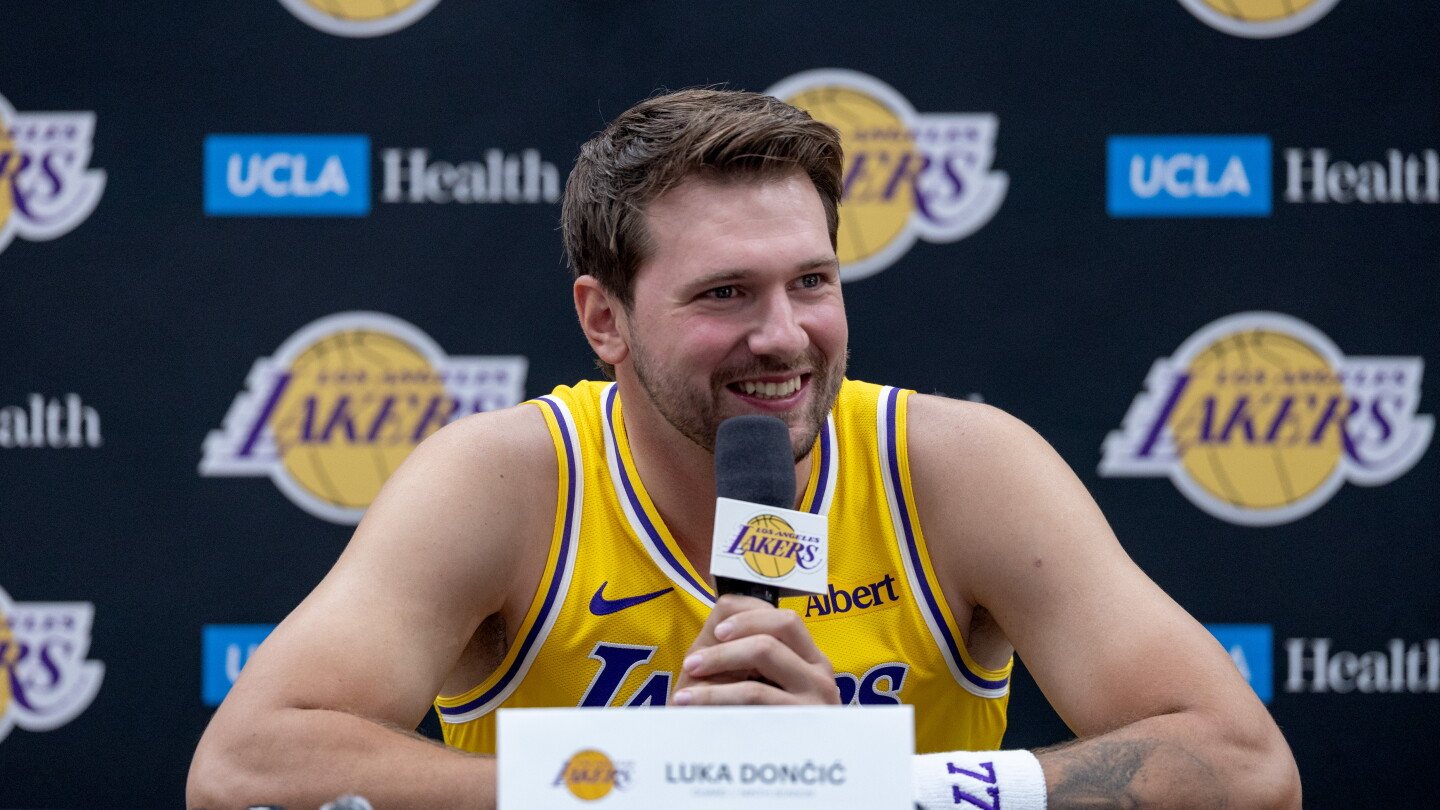
LeBron James was still a topic at Lakers media day, per NBC Sports, even though he is in Philadelphia now. He agreed to a two-year, $8 million deal with the 76ers on July 24, per Shams Charania. The easy version of the story is that the Lakers lost a scorer and need to find 20 points a night. I don’t think that’s the problem.
My take: LeBron’s scoring is the part of his game the Lakers can absorb. His passing is the part they can’t, and the shooters they brought in do little for it.
The numbers below are from Basketball Reference’s 2025-26 Lakers page and the player pages.
What actually left
LeBron played 60 games last season at age 41 and averaged 20.9 points, 6.1 rebounds and 7.2 assists in 33.2 minutes. He logged 1,989 minutes, which is 10.1% of every minute the Lakers played by anyone (19,705). His points per game times games played works out to roughly 13% of the team’s scoring, since the Lakers averaged 116.3 over 82 games. His assists, 7.2 over 60 games, come to about one in five of the team’s total.
Those two shares are not the same size, and that gap is the whole argument. He took 13% of the points and a fifth of the passing.
The scoring is the easy part
LeBron’s true shooting was .594, a shade under the team’s .609. He shot 31.7% on 4.1 threes a game, while the Lakers as a team hit 35.9%. Part of what the Lakers lost was a high-usage wing (27.2% usage, per Basketball Reference) who was a below-average three-point shooter for his own roster.
The players who arrived from other teams answer that directly. Per Basketball Reference’s 2025-26 lines:
- Collin Sexton: 15.4 points, 40.1% from three on 4.1 attempts, across Charlotte and Chicago in 68 games.
- Sandro Mamukelashvili: 11.2 points, 38.9% on 3.7 attempts for Toronto in 80 games, a stretch big who can back up Walker Kessler.
- Quentin Grimes: 13.4 points, 33.4% on 5.1 attempts for Philadelphia in 75 games.
- Ziaire Williams: 10.2 points, 34.3% on 4.5 attempts for Brooklyn in 56 games.
Add Austin Reaves at 36.0% on 6.4 threes a game and Luka Doncic at 36.6% on 10.8, and the Lakers can put four or five credible shooters around a driver. LeBron took 4.1 threes a game and made fewer than a third of them. Sexton and Mamukelashvili clearly beat LeBron’s 31.7%, and Grimes and Williams are a couple of points better. Scoring has a lot of replacements.
The passing is the hard part
Assist percentage estimates the share of teammates’ baskets a player assisted while on the floor. Last season Doncic led the Lakers at 40.5%. LeBron was second at 34.1%. Reaves was third among the regulars at 24.0%, in 51 games.
Now look at those four, plus holdover Jake LaRavia:
| Player | 2025-26 team | Assist % |
|---|---|---|
| Collin Sexton | CHA/CHI | 21.7 |
| Quentin Grimes | PHI | 15.7 |
| Sandro Mamukelashvili | TOR | 12.4 |
| Jake LaRavia | LAL | 9.3 |
| Ziaire Williams | BKN | 7.4 |
Sexton, a score-first guard who averaged 3.3 assists, is the only one within reach of Reaves. Everyone else is a finisher. Doncic averaged 8.3 assists last year with a usage rate of 38.1%, so the ball will be in his hands anyway. It also means the Lakers have two proven creators, and one of them, Reaves, played only 51 games.
LeBron was the second-best passer on the team by assist rate. A team with three creators can lose one to a rest night or a sore hamstring. A team with two cannot.
The Doncic problem
Doncic averaged 33.5 points a game last season, but he played 64 of 82 games. Reaves played 51. LeBron played 60. Take LeBron out and the Lakers have to cover about 33 minutes a night of high-level passing from somewhere else.
Rob Pelinka said in a press conference, per NBC Sports, that the team is “grateful for the run that we had with [LeBron] here” and wanted to turn to “a new chapter.” Doncic told ESPN’s Brian Windhorst, “It was kind of sad. Playing with LeBron was amazing. There’s a lot of things I learned from him…” Neither tells you who runs the offense on the night Doncic is resting.
Who fills the gap
There are three candidates.
Reaves. He’s the obvious one. He averaged 5.5 assists in 34.5 minutes on a 24.0% assist rate, and he is the newly signed co-leader of this team. Jake LaRavia described the arrangement at media day: “I think sometimes Luka leads by example and we watch him and we watch how he goes about himself. AR can sometimes be a bit more vocal.” Reaves has to lead the locker room and create shots for four other players.
Sexton. He has the highest assist rate of the new arrivals at 21.7% and plays the old-school score-first guard role. His assist rate sits next to a 25.9% usage rate, which is a guard who creates for himself first.
Bronny James. His assist rate was 18.1% in 375 minutes, with a 17.5% turnover rate. NBC reported he could crack the regular rotation. The sample is too small to build around.
My read is that Reaves carries the main load and the Lakers lean on Doncic to run the offense for 36-plus minutes. That works as long as he is healthy. His 35.8 minutes a game last season were already a lot, and I’d want to see Redick cut it.
What I’d watch
The regular season opens Wednesday, Oct. 21 against Golden State. The preseason, including tonight’s game against Sacramento, is where Redick can test the second-unit guard. Two things to track:
- Who initiates when Doncic sits. If it is Reaves every time, he’s overworked. If it’s Sexton, the bench offense will look different from last year’s.
- Doncic’s minutes. Anything near 36 a night means the plan has no plan B.
I wrote about the preseason stakes in our look at the Warriors loss and Redick’s “unacceptable”, where Doncic, Reaves, Kessler and Sexton all sat. And the defensive side of the rebuild is covered in how Kessler ended up a Laker. The Lakers added shooting. The question for the next six months is whether anyone besides Doncic can run the offense.