
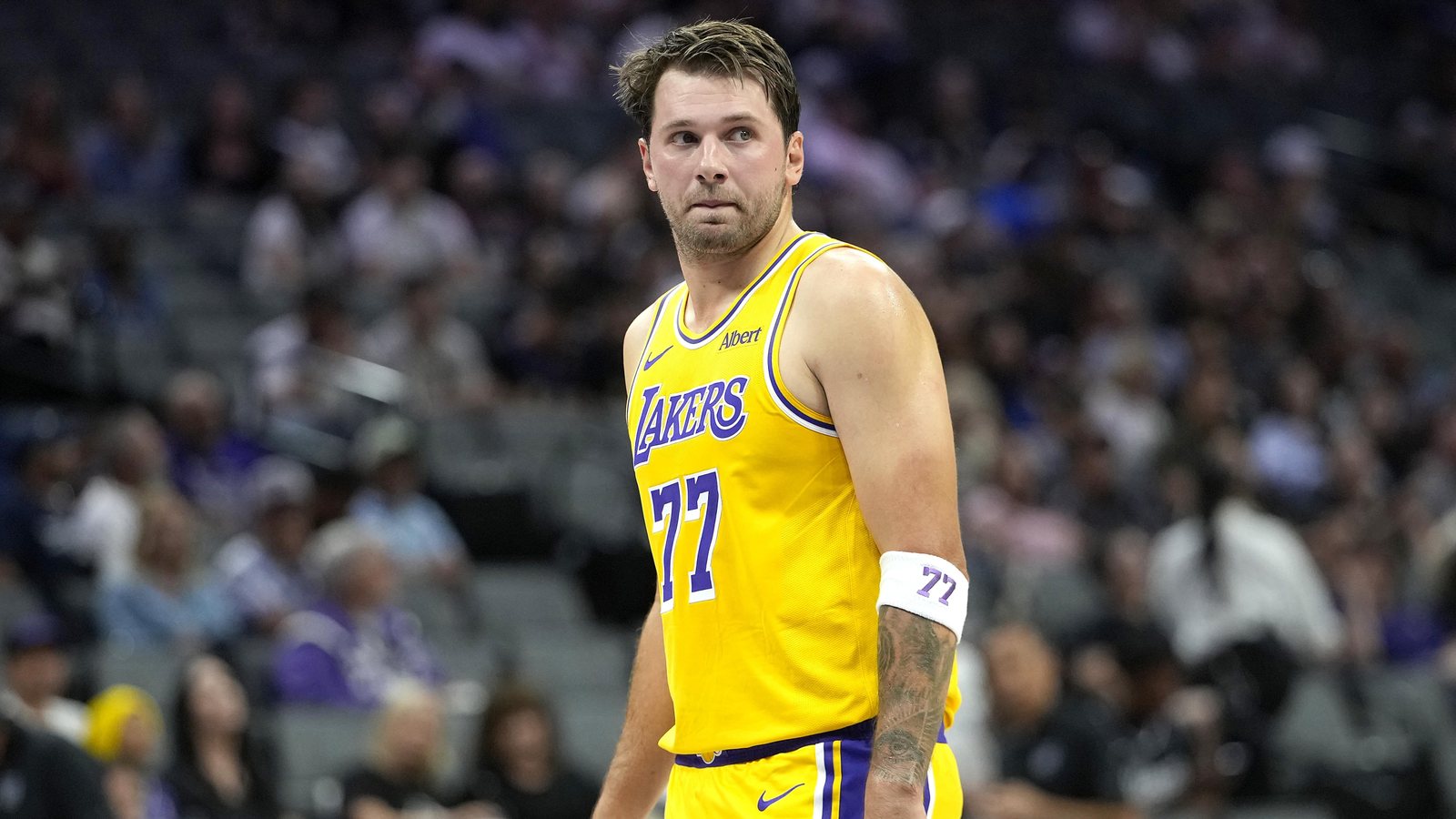
Luka Doncic played 38 or more minutes in 27 of his 64 games last season, per Basketball Reference. In the five games before he got hurt at Oklahoma City on April 2, he played 38.2, 38.8, 37.5, 38.7 and 34.0 minutes. The Lakers should hold him to about 34 minutes a night this season, with no more 38-minute games unless a game demands it.
The Lakers went 43-21 with Doncic on the floor last season and 10-8 without him, per Basketball Reference. They were 53-29 overall. What they did not have in the playoffs was Doncic: he was inactive for all 10 games, a first-round win over Houston and a sweep at the hands of Oklahoma City.
What he did when he played
Doncic’s 2025-26, per Basketball Reference:
| Games | Minutes | Points | Rebounds | Assists | True shooting | Usage |
|---|---|---|---|---|---|---|
| 64 | 35.8 | 33.5 | 7.7 | 8.3 | .616 | 38.1% |
He scored 30 or more in 44 of those 64 games and 40 or more in 16, including 60 at Miami on March 19. He finished fourth in the MVP voting, per Basketball Reference. A usage rate of 38.1% means he finished close to two of every five Lakers possessions he was on the floor for, with a true shooting percentage (the efficiency number that counts threes and free throws) of .616.
Nobody on the roster replaces that. I wrote about it in what LeBron’s departure took with it: the Lakers have shooters, but Doncic is still the one who creates. When he sits, the offense has a hole.
The 18 games he missed
The Lakers were 43-21 with Doncic and 10-8 without. That is a .672 winning percentage against .556. Spread over 82 games, the gap is nine or ten wins.
It is also only 18 games. Five of them came after the injury, when the Lakers went 3-2 against Dallas, Oklahoma City, Golden State, Phoenix and Utah with the season nearly over, per Basketball Reference.
My read: a few more regular-season nights without him will cost the Lakers some wins, and I would take that trade. The missing star in the second round is the bigger loss.
What the heavy minutes bought
Here is the best argument against me, and it comes from the same game log. In the 27 games where Doncic played 38 or more minutes, the Lakers went 20-7 and he averaged 35.7 points. In the other 37 games he played, they went 23-14 and he averaged 31.8, per the Basketball Reference game log. That is a .741 winning percentage against .622.
I do not read that as proof that 38 minutes wins games. Close games and tight rotations pull a star into long nights, and a team that is winning close games wins plenty of them. But I will not wave it away either. Capping him costs the Lakers something on the nights it applies, and the 27 long nights were worth about a win in every eight games.
My answer is that the price is worth paying because the alternative has a worse tail. A .741 record in those 27 games did not stop the Lakers from losing their star for April and May. A star at 34 minutes who is on the floor for the first round, the second round and the Finals beats a star at 39 who is not.
April 2
The Lakers lost 96-139 at Oklahoma City that night. Doncic played 25 minutes and 42 seconds, scored 12 points and was minus-25, per the Basketball Reference game log. On Oct. 8 he told Sports Illustrated’s Chris Mannix that he tweaked his left hamstring in the second quarter, stayed in, and strained it in the third, a Grade 2 strain according to Bleacher Report’s account of the interview. “I definitely regret it,” he said. He added that he felt something in the first half and “should have just stopped. I should have come out.” He also called himself “just stubborn.”
Bleacher Report’s account also has Redick saying Doncic was cleared and that the team discussed sitting him and Reaves at halftime before keeping them in, with the Lakers down 31. A star who calls himself stubborn will keep playing, so the minutes plan has to be made before the game, not at halftime.
The recovery was slow. Before Game 2 of the conference semifinals, he told reporters in Oklahoma City that he had gone to Spain for platelet-rich plasma injections, and that he had come back too early from injuries before, per the Associated Press. The Lakers lost Game 1 of that series 108-90.
Why 34, and how
Doncic averaged 35.8 minutes in 2025-26. A target of 34 is about two minutes a night off his average. It removes the 38-minute nights, which he had 27 times.
Here is how I would get to 34:
- When the margin hits 20, he sits. The 96-139 loss is the extreme case, but the rule is simple.
- Sit him early in the second quarter and bring him back for the last six minutes of the half. That keeps him on the floor for the stretches that decide games.
- Pick one back-to-back second night a month and rest him. Take the loss on the chin if it comes.
Every one of these hands a few more possessions a night to the second unit.
Who covers the minutes
In my piece on Collin Sexton, I argued he should run the second unit for 25 minutes. A Doncic cap makes that bigger: Sexton is the guard I would trust with a lead when Doncic sits. Austin Reaves cannot do the bench job and the starter’s job.
The backcourt is only part of it. Walker Kessler’s minutes and who backs him up matter more when Doncic is not driving into the paint; I sorted that out in the backup center debate. And the ball-security problem I looked at in the preseason turnover piece gets worse when the Lakers are running offense without their best passer.
What to watch Wednesday
The Lakers open Wednesday, Oct. 21, at 10 p.m. ET against Golden State, per Basketball Reference. Doncic played 40 minutes and 59 seconds in last year’s opener against the same team, scored 43 points and the Lakers lost 109-119.
Watch his minutes. If he is near 34 in a close game, someone made a plan. If he is over 40 again, nobody did.