
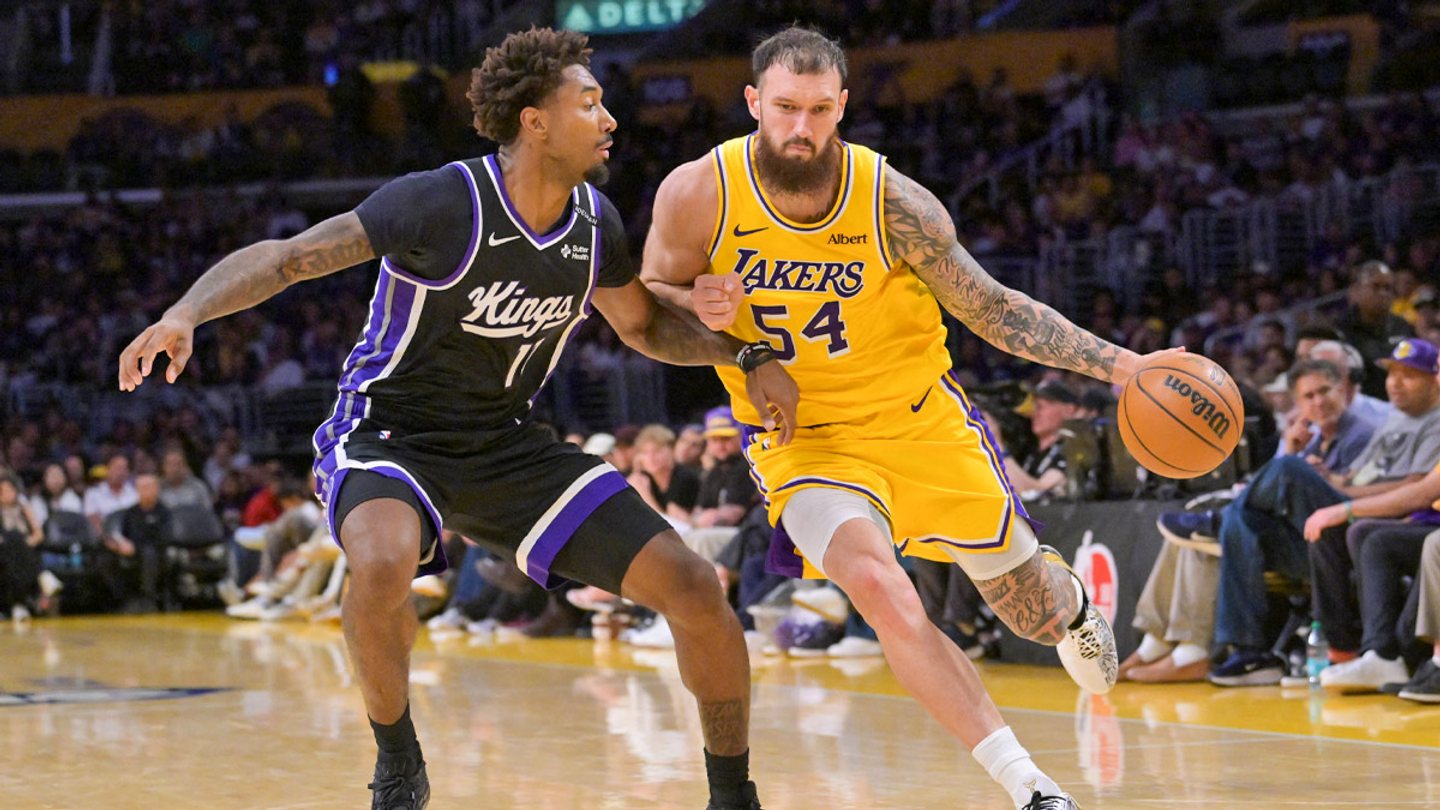
Sandro Mamukelashvili made 115 three-pointers for Toronto last season, according to Basketball Reference. I want the Lakers to try putting that shot next to Walker Kessler. Give Mamukelashvili a real stretch at power forward, where his offensive contribution can survive without asking him to be the lineup’s last defender at the basket.
As of Sunday, Oct. 25, my preferred experiment is simple: Luka Doncic, Austin Reaves, a wing, Mamukelashvili and Kessler. Start with a short rotation stint. Give the group a defined offensive assignment and a defensive matchup it can reasonably handle. There is enough shooting in Mamukelashvili’s recent record to justify finding out whether the two big men can share the floor.
The Shot Deserves More Than Backup-Center Minutes
The Basketball Reference totals make a stronger case than an encouraging preseason night. Mamukelashvili shot 115-for-296 from three in 80 games for Toronto in 2025-26, a listed 38.9%. The previous season in San Antonio, he went 60-for-161, or 37.3%. That is consecutive seasons of useful shooting with a substantial increase in attempts.
Combined, those two seasons produced 175 makes in 457 attempts, or 38.3%, by my calculation. That does not guarantee the next open jumper. It does give me a better reason to trust the shot than whatever happens on his next few possessions. Basketball Reference has him at one make in three attempts through his first two Lakers games. Three shots should barely get a vote in this discussion.
The important choice is where to use that shooting. At center, Mamukelashvili can pull a defender away from the basket. Beside Kessler, I would ask him to keep a second big defender occupied while Kessler screens and rolls. That is a different offensive job, and it deserves its own trial rather than being treated as a consolation prize for losing the backup-center argument.
Picture the possession I would draw up. Doncic uses Kessler’s screen, with Mamukelashvili positioned beyond the arc on the opposite side. If Mamukelashvili’s defender steps into Kessler’s path, Luka has an outside target. If that defender stays attached, the roll has one less helper waiting for it. The whole point is to make the help defense choose before it can cover both options.
Keep Mamukelashvili out of the dunker’s spot on that action. Parking him near the baseline would bring his defender closer to the very space Kessler is trying to reach. Use the shot the Lakers have. Asking a willing shooter to stand next to a rolling center is a strange way to complain about a crowded paint.
There is room for a second action, too. If Doncic gives the ball up and the defense closes toward Mamukelashvili, I want a quick decision: shoot the available three, move it to Reaves, or attack the opening. Reaves should have room to use the next screen instead of watching the possession stall while everyone waits for Luka to receive the ball again. That fits our argument for keeping Reaves involved as a creator.
Mamukelashvili’s passing totals offer a reason to try that responsibility. Basketball Reference records 151 assists and 67 turnovers for Toronto last season, about 2.25 assists per turnover by my calculation. Those totals cannot tell us how he will handle a particular trap. I would still trust him with a quick passing decision rather than design a role in which every touch has to become either a shot or an immediate return to Doncic.
He also made 215 of 335 two-point attempts last season, a listed 64.2%, per Basketball Reference. That supports leaving room for him to finish inside when the opportunity appears. Use those chances selectively beside Kessler: attack a closeout with an open lane, cut when Kessler moves away, and avoid sending both big men toward the same patch of floor.
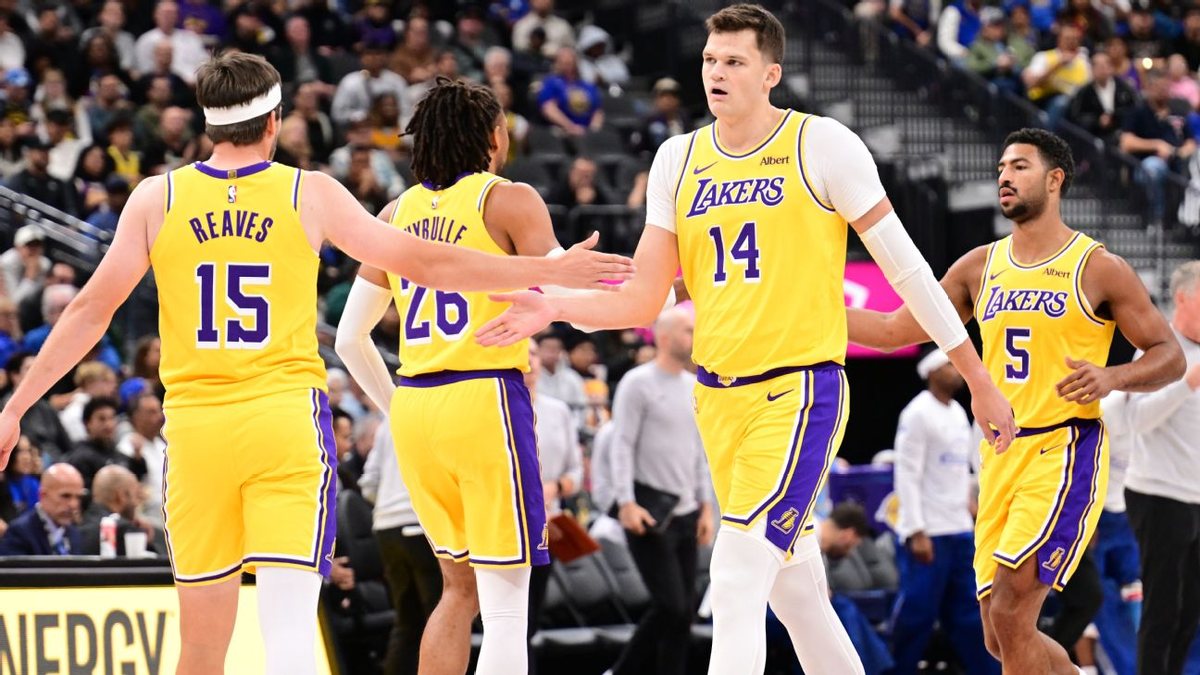
Kessler Gives the Experiment a Defensive Starting Point
The defensive case begins with the job I would give each player. Kessler takes the center assignment and the first responsibility for protecting the basket. Mamukelashvili takes a forward matchup. Moving him beside Kessler would let the Lakers test his offense while assigning the primary interior work to their starting center.
The distinction has a statistical foundation. In 2024-25 with Utah, Kessler averaged 12.2 rebounds and 2.4 blocks across 58 games, according to Basketball Reference. His total rebound percentage was 21.9%, an estimate of the available rebounds he collected while playing. Mamukelashvili’s figure for Toronto last season was 12.8%. These are different seasons and teams, but the gap is a good reason to give them different responsibilities.
Their block percentages point the same way: 7.4% for Kessler in that Utah season and 2.3% for Mamukelashvili in Toronto, per Basketball Reference. The statistic estimates the share of opponents’ two-point attempts a player blocked while on the court. It does not grade every contest or rotation. I would use it to resist assigning Mamukelashvili the same defensive job simply because both men can appear at center on a lineup card.
We have already made the rebounding case for Looney over Mamukelashvili as Kessler’s backup. Playing Mamukelashvili beside Kessler asks a separate question: can his shooting earn forward minutes while another big handles the middle? I would make this a matchup choice before making it a starting-lineup decision.
My first trial would come against an opponent using two bigger frontcourt players. Put Mamukelashvili on the forward, keep Kessler involved near the basket, and see whether the Lakers can complete possessions without sending extra help everywhere. I would be much less eager to force the pairing against a group that repeatedly puts Mamukelashvili in space against a fast perimeter scorer. A lineup experiment should come with an exit door.
Kessler’s presence also cannot become permission for Mamukelashvili to watch rebounds. If Kessler challenges the shot, his partner needs to find a body and pursue the miss. Judge the pairing on that handoff of responsibility. Giving up another possession after a good contest would erase much of the benefit of keeping a second big on the floor.
On offense, the test is equally visible. Does Mamukelashvili get clean catches outside while Kessler rolls? Does his defender have to leave a useful helping position? Can the ball reach Reaves for another attack without a reset? I would keep the group together long enough to answer those questions, including through a couple of missed open shots, then change it if the defensive assignments keep breaking down.
The shot gives this pairing a reason to exist. Give Mamukelashvili space outside, Kessler room to roll, and the two of them a fair trial together.